Because break-ins and suspicious activities frequently happen under the cover of darkness, a camera's ability to record clear footage in low-light environments is arguably its most critical function. The industry employs a few distinct technologies to achieve this, primarily traditional Infrared (IR) night vision and newer Color night vision.
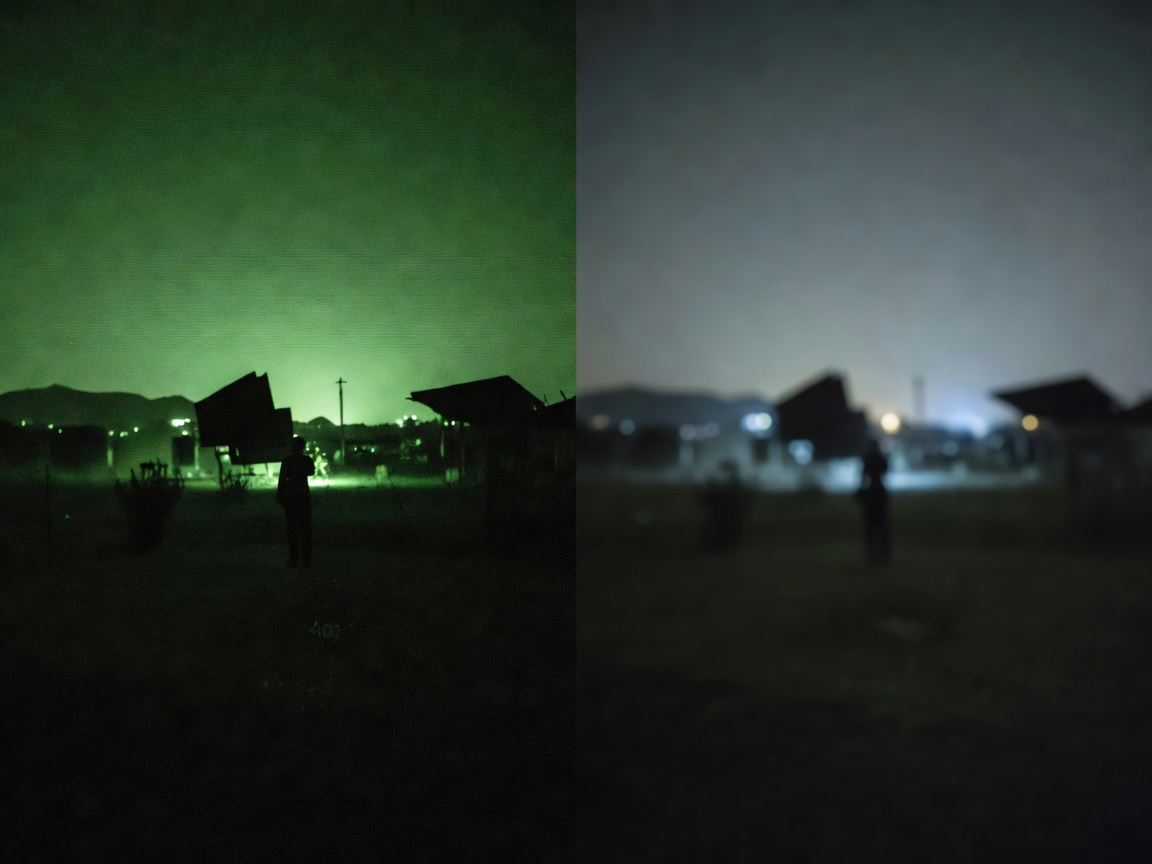
Traditional Infrared (IR) Night Vision
Infrared night vision has been the industry standard for decades. Cameras equipped with this technology are surrounded by a ring of small LED lights that emit infrared radiation. While invisible to the human eye (apart from a faint red glow on the camera itself), the camera's sensor can see this light perfectly.
When the ambient light drops below a certain threshold, a mechanical filter inside the camera clicks into place, and the IR LEDs turn on. The resulting footage is monochromatic (black and white).
- Pros: Extremely reliable, works in pitch-black conditions where there is zero ambient light, and is generally very cost-effective.
- Cons: Cannot capture color details (like the color of an intruder's jacket). Objects that get too close to the camera can become "blown out" or intensely overexposed by the IR reflection. It also cannot see through windows, as the IR light reflects off the glass back into the lens, blinding the camera.
Color Night Vision (Starlight Sensors)
Color night vision is a newer technology made possible by advanced image sensors—often referred to as "starlight sensors"—paired with wide apertures that allow massive amounts of light to hit the sensor.
Instead of relying on invisible IR beams, these cameras aggressively amplify the tiny amounts of ambient light present in the room (from streetlights filtering through blinds, or a distant nightlight) to produce a full-color image.
- Pros: Provides crucial identifying details (hair color, clothing color, object color) that black-and-white IR misses. Results in an image that looks much closer to daylight.
- Cons: It requires some ambient light to function; it will not work in a room that is essentially a pitch-black windowless box. In very dark conditions, moving objects can sometimes appear blurry because the camera has to lower its shutter speed to absorb enough light.
Integrated Spotlights
To bridge the gap, many modern cameras use a hybrid approach. They act as standard IR cameras in the dark, but if motion is detected, they activate a small, bright white LED spotlight. This sudden burst of light illuminates the subject, allowing the camera to switch over to full-color recording while simultaneously acting as a deterrent to intruders.
For indoor use, an active spotlight can be startling, so this hybrid approach is more commonly found on outdoor models, though it is appearing on premium indoor/outdoor versatile units.
Conclusion
When selecting a camera, assess the lighting environment of the room. If the room has large windows admitting ambient street light, a color night vision sensor will perform beautifully. For a windowless basement or interior hallway, traditional IR night vision remains the undisputed champion of reliability.